
LIVES LAID DOWN
“Greater love has no one than this, that he lay down his life for his friends”
(John 15. 13)
UNION flags fluttered from flag poles. The crowds waved their Union Jacks as Her Majesty Queen Elizabeth’s Platinum Jubilee was celebrated. In a short time, the flags lay limp at half-mast as the nation mourned the passing of their monarch. Then, crowds gather, the flags are again waved as we mark the accession of King Charles to the throne.
The Union Flag unites us as a nation, both in peace and in war. The Rev David Railton MC was the padre who had the idea for the Tomb of the Unknown Warrior in Westminster Abbey following World War One. He also provided the Union Flag which was draped over the coffin of the warrior. This was the flag that accompanied him in his ministry in the trenches. It was used to cover the bodies of the fallen. Before the ceremony in the abbey the blood stains had to be removed and the flag patched.
Expression
1. How do we remember? In ordinary life, we know there is no greater expression of self-denying love for one’s friends than being willing to lay down one’s life for them. During World War One millions died. So, with the bodies of the British fallen not returning home to family, there was a ground swell for memorials. War memorials and memorial halls in villages and towns across the country were created as a response to the popular need to mourn. Written on many memorials were the words from John 15. 13, “Greater love hath no man than this, that a man lay down his life for his friends.”
Remembering the past and bringing the past into the present is central to the Gospel. In the Old Testament we see a name is kept alive by remembering it. Take the story of Absalom, who having no son sets up a pillar so his name is remembered. 2 Samuel 18. 18 : “it is called Absalom’s pillar to this day”.
In the Lord’s Supper, we remember through bread and wine Jesus the Son or God: “do this in remembrance of me.” Here the death of Christ is brought into our present experience in this simple meal. At 11 am on November 11 the country remembers the fallen at memorials across the land.
2. Why do people in the forces lay down their lives? We recall Jesus’ words that people lay down their lives for “their friends.” Friendship comes at various levels. Anything from acquaintances to best friends. Best friends provide those soul-feeding relationships. They “get” who you are. John Wimber wrote “People come to church for various reasons, but stay for only one, they make friends.” As in church, so in the forces. Relationships are essential. People are comrades, especially in conflicts and war. These relationships feed the character.
In 2003, as a padre, I went to war, the Iraq War. Before invasion, as soldiers living in the Kuwait desert, we knew we were preparing for war. We knew we could die, possibly from “weapons of mass destruction.” Soldiers aren’t stupid. We knew at home there were campaigns against the war and we had mixed feelings. When visiting the troops, the discussion topic was war ethics and whether there were weapons of mass destruction.
Comrades
Once the decision was taken to go to war, speculation ceased. We were comrades, working for a common goal. We were willing to die, not for Blair, not for Queen or for country, but for each other. Such comradeship is something I miss as a veteran. Although the Royal British Legion, in their local branches, helps provide this. Where people “get you’ and understand what you have been through.
At Remembrance we recall the blank cheque every service person signs. No one wants war, war is terrible and horrendous. It is countries who “go to war,” not individuals. Soldiers will always prepare for war, but prefer to live in peace.
3. What does it mean to give our life for our friends? Jesus Christ called us his “friends” (John 15. 14-15). There are different ways that people lay down their lives for their friends. It isn’t only seen in the military! We see it every day. All year long. We see ordinary believers who give their life in sacrificial service through their churches and in their local communities. The lonely are listened to, the hungry are fed, chapel toilets are cleaned, numerous cups of tea are served and costly friendship is offered.
I once had a conversation with a lady who, without fuss, cleaned the chapel toilets in a busy church each week. I asked her, “Am I right that you do this because of your love for Jesus?” She replied immediately “Oh yes, that’s why I do it.”
“What you leave behind is not what is engraved in stone monuments, but what Is woven into the lives of others” (Pericles). As we give our lives to others, God gives himself to us through the Holy Spirit, who creates in us the character of Jesus. He enables us to lay down our lives every day.
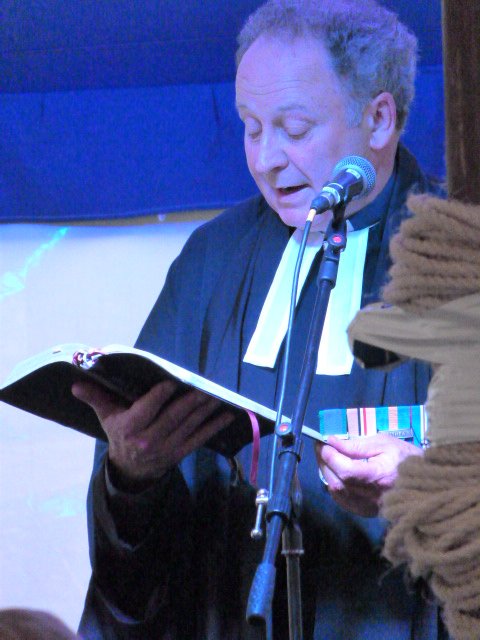
The Rev David Moss is a former army chaplain currently serving as superintendent minister of the Callington and Gunnislake circuit in Cornwall.
(Actual Article scanned click here)
 Meon Valley Methodist